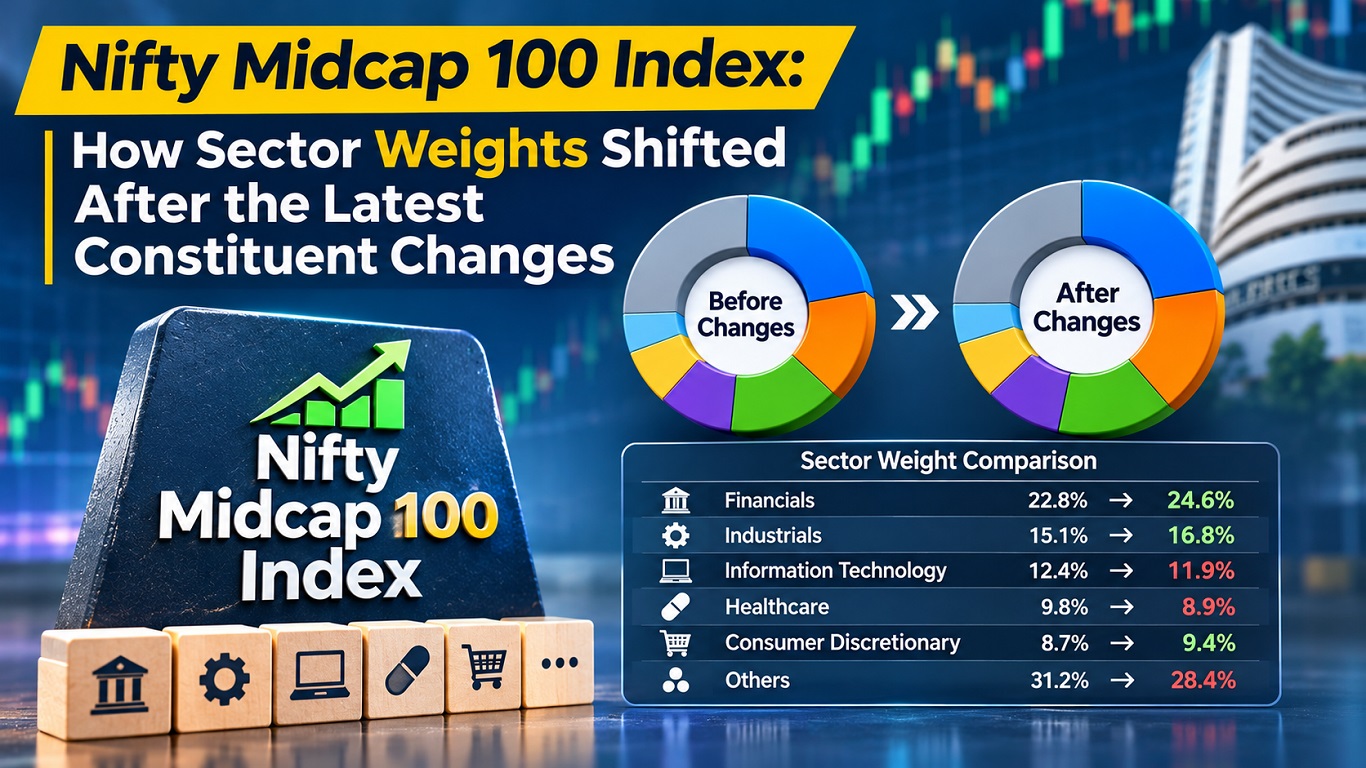
The Nifty Midcap 100 Index is designed to represent the performance of 100 companies from the mid-cap segment of the Indian equity market. As companies enter or exit the index during periodic reviews, the sector composition can also change. These constituent changes may alter the weight of financial services, industrials, healthcare, information technology, consumer companies, and other sectors. Understanding these shifts can help investors interpret why the Nifty Midcap 100 Index may behave differently from broader benchmarks such as the Nifty 50.
How Constituent Changes Affect Sector Weights
The Nifty Midcap 100 Index is reviewed periodically using predefined rules, and changes in its constituents can influence sector representation. When a company with a relatively large index weight is added, the sector to which it belongs may gain greater representation. Similarly, the removal or reduction in weight of a major constituent can reduce the influence of its sector. Therefore, sector weights do not remain fixed and can change as the underlying companies and their market capitalisation rankings evolve.
Why Financial Services Can Have a Significant Weight
Financial services companies are an important part of India’s equity market and can have a meaningful presence in the Nifty Midcap 100 Index. Changes involving banks, non-banking financial companies, insurance businesses, or other financial firms can therefore affect the index’s overall sector balance. If newly included companies have strong market capitalisation, financial services could account for a larger share of the index. Conversely, constituent exits can reduce its representation. Investors should check the latest index factsheet for the exact sector allocation after each review.
Industrial and Manufacturing Exposure Can Change
The industrial and manufacturing segments can also influence the Nifty Midcap 100 Index. Companies involved in capital goods, engineering, infrastructure, electrical equipment, chemicals, and manufacturing may move into or out of the index as their market capitalisation and eligibility change. An increase in such constituents can make the index more sensitive to economic expansion, capital expenditure, infrastructure spending, and commodity costs. A lower allocation can reduce that exposure.
IT and Healthcare Weights May Move Differently
Information technology and healthcare are other sectors that can experience changes following constituent reviews. IT companies may be influenced by global technology spending, currency movements, and demand from overseas markets, while healthcare businesses can respond to domestic healthcare demand, pharmaceutical cycles, and regulatory developments. When constituents from these industries change, the sector weights of the Nifty Midcap 100 Index may shift even when the overall number of companies remains unchanged.
Consumer and Other Sectors Add Diversification
Consumer-facing businesses, automobiles, real estate, telecommunications, energy, and other industries can also contribute to the index’s overall composition. The inclusion of companies from different industries can provide diversification, while the removal of constituents can increase the relative weight of sectors that remain. This is why investors should not evaluate the Nifty Midcap 100 Index only by looking at its total return. Its sector mix can provide important context about the risks and opportunities driving performance.
How Investors Should Read the Latest Changes
When analysing the latest Nifty Midcap 100 Index constituent changes, investors should compare the sector allocation before and after the review. The most useful indicators include the number of companies in each sector, their combined index weight, and whether the change represents a temporary market movement or a structural shift in composition. It is also important to distinguish between changes caused by constituent reviews and changes caused by share-price movements after the review becomes effective.
Conclusion
In conclusion, sector weights in the Nifty Midcap 100 Index can shift after constituent changes as companies enter, exit, or change their relative importance within the benchmark. Tracking these changes helps investors understand the index’s exposure to financial services, industrials, IT, healthcare, consumer businesses, and other sectors. However, sector weight changes should be considered alongside valuation, earnings growth, market conditions, and individual company fundamentals before making investment decisions.