
Picture two quotes sitting on a facility manager’s desk. Both are for removing old asbestos ceiling tiles from a 1970s office floor. One is a lot cheaper.
On paper they look alike. On site they won’t be.
Commercial buildings bring things a house job never does tenants, lifts, air conditioning that serves six floors, and a building that usually has to keep trading while the work goes on. A licensed commercial asbestos removalist is set up for that. Plenty of operators aren’t.
So, what’s the actual difference? It shows up in a few places.
It starts with the licence
In Australia, licensed asbestos removal comes in two classes.
Class A covers friable asbestos, the crumbly kind such as sprayed coatings and old pipe lagging. Class B covers bonded (non-friable) asbestos over 10 square metres, like cement sheeting and some floor tiles.
Commercial sites often have both. A single office refurb might turn up bonded wall sheeting on one level and friable lagging in the plant room. A contractor holding only a Class B licence can’t touch the second job.
Licences are issued by the work health and safety regulator in each state and territory, so ask to see the licence and check it’s current. It takes two minutes.
Planning before anyone arrives
A good removalist does a lot of work before the first crew member walks in.
They’ll start with your asbestos register. Workplaces built before 31 December 2003 generally need one, and on a commercial site it’s the first document anyone should read. If it’s out of date or doesn’t cover the areas being worked on, they’ll recommend further inspection and testing.
Next comes the asbestos removal control plan. It sets out what’s being removed, how, and with what controls. Then the regulator is notified before licensed work begins.
Cheap quotes tend to skip over this part. It’s also the part that protects you if anything goes wrong.
Working in a building that’s still running
Commercial experience counts most here.
Offices, shopping centres, schools, hospitals, and warehouses rarely close for an asbestos job. So, the work has to fit around the people still using them.
That might mean:
- Staging the job floor by floor or zone by zone
- Working nights or weekends
- Shutting down or isolating air conditioning serving the work area
- Setting up separate access routes for crews and waste
- Keeping tenants and building management informed
A licensed commercial asbestos removalist plans all of this with you, then sticks to it. A crew used to suburban garages may not know where to start.
Controls you can see
Walk past a well-run commercial removal and you’ll notice it straight away.
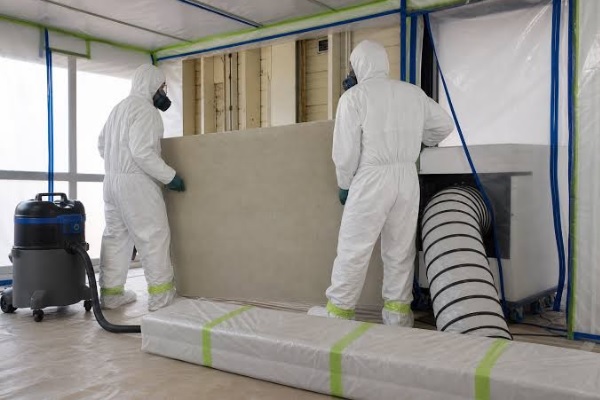
Signs and barriers mark the exclusion zone. Friable work happens inside a sealed enclosure under negative air pressure, with a decontamination unit for the crew. Air monitoring runs during friable removal. Bonded material is kept wet and taken out in as few pieces as possible.
It looks careful because it is.
Clearance and disposal, done properly
When each area is finished, it’s cleaned and inspected. For Class A work, the clearance inspection is done by an independent licensed asbestos assessor. For Class B, it’s an independent competent person. Either way, a clearance certificate is issued before the space is used again.
Waste is wrapped, labelled and taken to a facility licensed to accept asbestos, following the environmental rules in your state or territory.
You should end the job with a clear paper trail: the control plan, air monitoring results where relevant, the clearance certificate and disposal records. Your register should be updated too.
Red flags when comparing asbestos removal contractors
Most asbestos removal contractors do the right thing. A few don’t. Watch for:
- A quote far below everyone else’s with no clear reason
- No mention of the licence class, control plan or clearance
- Reluctance to show licences or insurance certificates
- Vague answers about disposal
- Pressure to start before testing is done
Any one of these is worth a follow up question.
Questions worth asking
Before you sign, put these to the asbestos removal contractors on your shortlist:
- What licence class do you hold, and does it cover every material on this site?
- Have you worked in occupied commercial buildings like ours?
- Who will supervise the job on site?
- How will you handle air monitoring, clearance, and disposal?
- Can you stage the work around our tenants and trading hours?
- Will you help update our asbestos register when you finish?
The good ones will answer quickly and without fuss. They’ve heard these questions before.
Making the call
Price matters. But on a commercial job, the cheapest quote can turn expensive fast if a tenant complains, an area fails clearance or work stops halfway through.
If you’re planning a refurbishment, fit out or demolition in an older commercial building, start with your asbestos register. Then talk to a licensed commercial asbestos removalist early, while there’s still time to build the work into your program.


